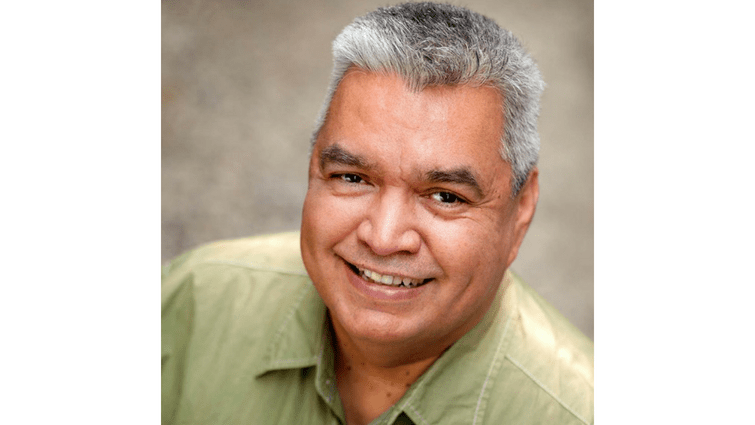
 Russell Wallace is a composer, writer, producer and is a traditional Lil’wat singer from Mount Currie. Wallace’s music has been part of a number of soundtracks (film, video, television) and theatre/dance productions. He studied Film Studies and Creative Writing at Capilano University and University of British Columbia and has been published in anthologies and periodicals. Wallace is the Culural Coordinator at NEC Native Education College, and teaches at Simon Fraser University and Capilano University’s Kexwusm-ayakn Student Centre. He recently received a Leo Award for Best Musical Score for a documentary series, “1491: The Untold History of the Americas Before Columbus”.
Russell was unable to attend and speak at the VIM House Conversation at Creekside Community Centre on Tuesday, September 18. The following letter was read at the beginning of the September proceedings:
Thank you for giving me the opportunity to share some thoughts. A little bit about myself, I am a composer, producer and traditional singer from the Lil’wat Nation in BC. My music has been part of a number of soundtracks (film and television) and theatre/dance productions across Canada. Most recently I received a Leo Award for Best Musical Score for a documentary series, “1491: The Untold History of the Americas Before Columbus”.
It is really great that a music centre is finally coming to Vancouver. It must have taken a lot of determination and work to get to this point. I am thankful that there are musicians and supporters of music coming together to accomplish this wonderful thing. I do have some ideas and dreams that I hope to share with you all.
Being a musician there are many times where we are required to act as a manager, agent, and presenter. Many times I have had to find an appropriate space for a music project and have had to make many compromises due to funding and accessibility to performance spaces. Coming from a background in traditional Salish music I find it challenging to compete for funding that sees traditional music as folk music. There is a lack of knowledge about Salish music and it is not being helped by the academic institutions where one can learn about every music from around the world except for the music that has been here for 10,000 years.
My hope is that there will be plenty of opportunities for Salish music to be presented, documented, and shared.
I have been part of the arts community in Vancouver for over 30 years and find there is a tremendous opportunity for collaborative works, intercultural exchanges, and multi-discipline presentations that can only happen in Vancouver because of our unique histories and communities. For example; where else in the world can you find Salish singers collaborate with Taiko drummers?
Please consider that inclusivity and all that it can bring. I worry about new arts organizations that slowly become like old arts organizations using hierarchical models of exclusivity.
Let’s celebrate Vancouver’s music diversity in a way that the world will take notice and want to be a part of.
Thank you all for your work and dedication to this great and wonderful vision.
In peace, Russell Wallace

 Russell Wallace is a composer, writer, producer and is a traditional Lil’wat singer from Mount Currie. Wallace’s music has been part of a number of soundtracks (film, video, television) and theatre/dance productions. He studied Film Studies and Creative Writing at Capilano University and University of British Columbia and has been published in anthologies and periodicals. Wallace is the Culural Coordinator at NEC Native Education College, and teaches at Simon Fraser University and Capilano University’s Kexwusm-ayakn Student Centre. He recently received a Leo Award for Best Musical Score for a documentary series, “1491: The Untold History of the Americas Before Columbus”.