
by Nou Dadoun
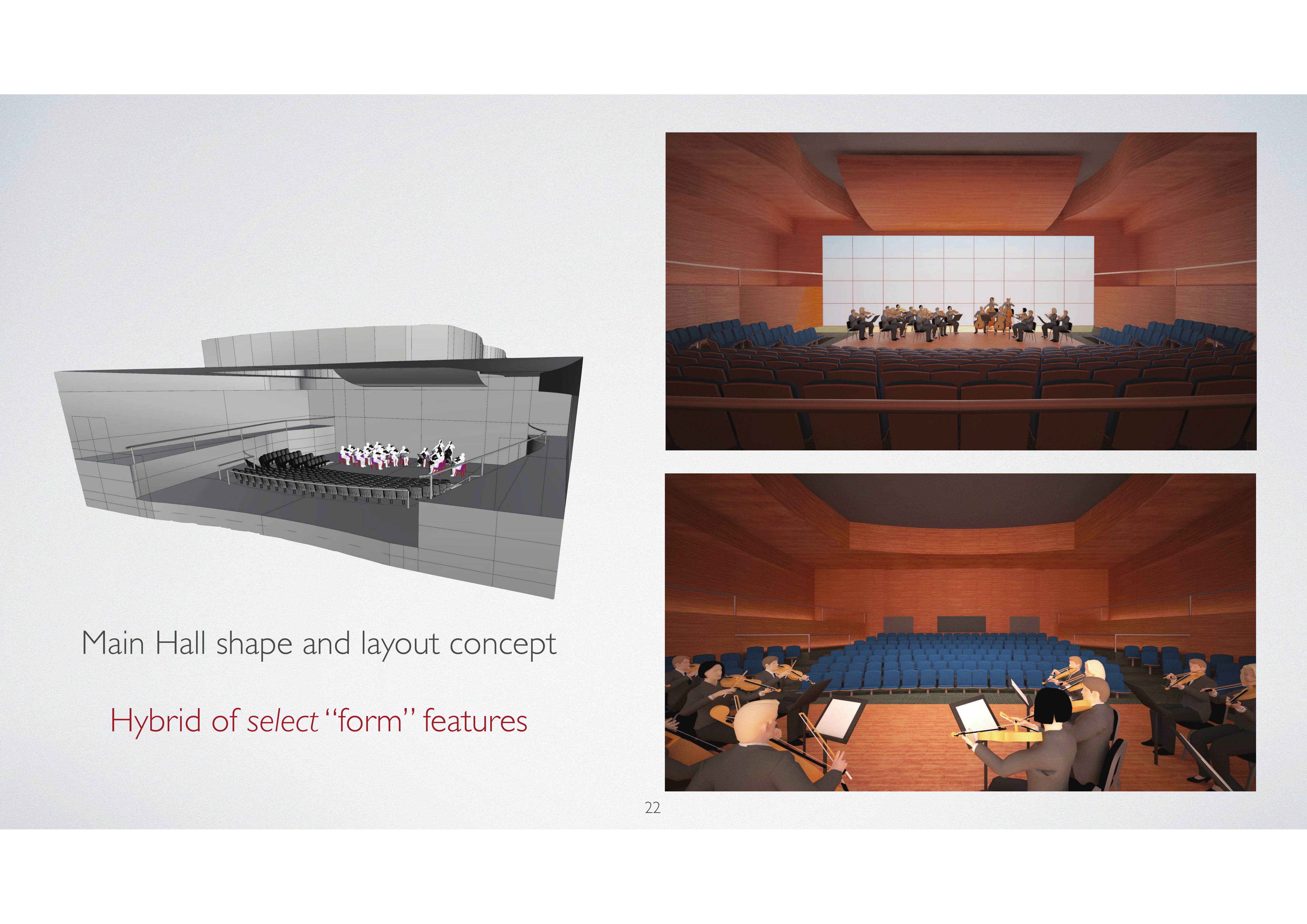
Concept drawing from our Acoustic Design Study
By all accounts a music venue is a precarious operation. In all cities music venues come and go, falling victim to any one of a number of ills—redevelopment, lack of booking availability for music, rising costs, misadventure and pure neglect. Over the years, all of these causes have felled legendary Vancouver music venues, from the Vancouver East Cultural Centre changing its focus to theatre, to the mysterious fire at the cooperative Glass Slipper, to the destructive abandonment of the historic Pantages Theatre, and so many more. Some, like the historic 1920s venues the Commodore Ballroom and the Orpheum Theatre, have survived their many challenges over the years, but more commonly venues don’t beat the odds, and what remain are only memories of spaces long gone in which Vancouver music fans had their musical coming of age.
Live music has the power to be a transformative experience, but music venues have the potential to be even more than that. They can be the anchors of a music scene that build shared musical experiences into a community. Spaces where the musical and social needs of musicians and fans are met, where there is room for collaboration and cross-fertilization and where the continuity of a gathering place connects the local scene to the larger national and global music communities.
This is part of the vision of the Vancouver Independent Music Centre, also known as the VIM House project, which has pulled together stakeholders comprised of musicians, music presenters, sound engineers, media, concert-goers, aficionados and like-minded souls to work towards the realization of an independent music venue in Vancouver. The name VIM House is an aspirational tongue-in-cheek recognition of the legendary BIMHUIS, a purpose-built music venue in Amsterdam with 225 fixed seats and the capacity for an additional 100 people standing, which holds more than 300 concerts per year, covering jazz, improvised, world and other chamber music. Its focus on the musical experience in terms of acoustics and visibility, the diversity of its programming, its access to the community and sustainable management has inspired the development of the VIM House.
The roots of the VIM House go back to the post-Expo 86 era when the appetite and sophistication of music audiences in Vancouver were growing in parallel to the expansion of the Vancouver Folk Music Festival, the Coastal Jazz and Blues Society, Early Music Vancouver and many other public and private presenters who were developing year-round music series. A group of like-minded presenters started noticing that many of the venues that they had become accustomed to using were raising their rates to unaffordable levels or were simply not available for booking at all. Of the spaces that were available, none were purpose-built for music and were, in most cases, far from perfect acoustically.
Some initial meetings were held about possible solutions to the space problem, but the presenters eventually accepted that they were going to have to get very creative and compromise significantly in finding musical performance spaces. For example, presentations by Early Music Vancouver bounced from church to church for many years. This increase in the use of multi-purpose spaces, like churches, raised many issues: having to share space with other groups; the need to setup and tear down the space before and after every performance, often without proper access for load in and out facilities; no front-of-house amenities like box office and ticketing; inadequate bathroom facilities; and, all too often, bad sightlines and poor acoustics. Although the presenters and their audiences learned to make do with what was available, the seed was planted for a collaborative solution to these problems.
Fast forward to post-Olympics Vancouver: a group of musicians, presenters and managers realized that music venues were closing or becoming inaccessible. They began to take the situation more seriously and established the Vancouver Independent Music Centre Society in 2011. The City of Vancouver Cultural Services office had been aware of these issues for a long time—they had supported studies into a proposed Coal Harbour Arts Complex, which was to include concert venues as developer-supplied cultural amenities but those plans were scuttled when the designated site was repurposed for the expansion of the Vancouver Trade and Convention Centre. At that point the whole question of a purpose-built venue for music in Vancouver was up in the air.
The new group soon commissioned a needs assessment, canvassing a wide cross-section of stakeholders in the Vancouver music community, including presenters, musicians, fans and techs involved in production. The consensus was that there was an urgent need for a music space. This was enough impetus to solicit and obtain Vancouver City Cultural Services funding for a feasibility study of a music centre, which was conducted by Donald Luxton and Associates, a well-known firm that specializes in cultural and heritage planning.
Luxton produced an extensive feasibility study in 2013, available at www.vimhouse.ca. The report surveyed existing venues around the world that could serve as models for a Vancouver venue and laid out three detailed options for a concert venue ranging from an 11,000 square foot space costing $5.1 million to the recommended option of a combined 25,000 square foot space for $11.5 million, excluding land costs. The hope was that the City of Vancouver, having funded the study, would step up with the land and that other levels of government would provide the support to kickstart the fundraising. The proposals within the study are ambitious but sensible and amazingly thorough, covering a financially sustainable operating model, configurable performance spaces, high tech AV infrastructure for performance streaming and convenient and affordable community access for performance, rehearsal and education.
Although the feasibility study accounts for varying space sizes and potential secondary uses, the core vision for the music centre includes two distinct performance spaces. The main hall should accommodate 225-325 seats for a formal concert hall and the secondary space should be some combination of a “Performance B” room and a rehearsal facility with a capacity of up to 150. The business and social aspects could be supported with a bar and refreshment space to subsidize the operation of the centre and provide an informal place for artists and audiences to meet and mingle.
One of the report’s central recommendations is that, as a venue purpose-built for musical performance, the VIM House must have superior acoustics, without which the core mandate of the facility would go unfulfilled. This includes not only the acoustics of the performing spaces but the requirement that each of the performance spaces is isolated from the other and the outside environment. In an urban setting like Vancouver, it’s all too common for an intimate performance like a solo piano concert to be interrupted by an ambulance’s siren speeding by outside.
A follow up acoustic design study was commissioned from ARUP Consultants, with a team led by architectural acoustician Larry Tedford, which was delivered in the spring of 2017. In May of 2018, Tedford conducted an open forum entitled LISTEN UP! A Conversation Series on Sustainable Models and Strategies For a Vancouver Music Centre for the VIM Society.
Tedford began by emphasizing what concert hall designers and music-loving audiences have long known: acoustics isn’t something that can be “fixed” after a hall is built, it needs to be a primary consideration at the outset. Taking as a starting point the Luxton and Associates feasibility study’s division of the Centre into two performance spaces, Tedford began by discussing the acoustic design goals for the main hall.
The acoustics of the main hall should support an intimate and enveloping sound, while allowing for clear and balanced sound for the performers on a stage sized to accommodate up to 25 musicians. The ability for musicians on stage to hear themselves and each other is as important a consideration as delivering the best possible sound to the audience.
As a music centre which aspires to collaboration and cross-fertilization across different types and disciplines of music, adaptability is important to accommodate a wide variety of musical genres and performance types. The overall shape of the hall should allow audiences to be near and around the stage to promote intimacy and afford excellent sightlines. Ideally the space should have natural light to create a sense of openness and should use finishes and an aesthetic that reflect and reinforces the centre’s Vancouver and West Coast environment.
Tedford outlined options for the shape of the main hall. The classic shoebox shape, as simple as it sounds, is the traditional building geometry of the world’s greatest concert halls, with excellent sightlines and consistent acoustic experiences across the audience. The modified fan design, expanding outward from the stage, retains the acoustic excellence of the shoebox design while improving audience intimacy with seating at the sides of the stage. The jazz room shape puts the stage and performers at the sides of a modified shoebox and, in bringing the audience closer, gives a direct and immediate acoustic experience suitable for a wide variety of music styles. The operetta style employs a rounder shape with added balconies, which brings more of the audience closer to the stage for more consistent sightlines and direct acoustic experience, while also having the potential to increase capacity. With the goal of having the best possible acoustic experience for a wide variety of musical genres, a hybrid room form may be able to combine the best elements of jazz, modified fan and operetta designs.
Another acoustical design consideration is the fact that sound is simply energy moving air; some shapes, like the modified fan, tend to dissipate the energy while others like the shoebox or jazz room conserve the energy and can give a more focused sound. Building materials can be important in conserving energy, like concrete or glass, absorbing energy, like curtains or baffling, or something in between, like wood, which can also reinforce the warm West Coast aesthetic.
There’s also what Tedford called “cheating”—subtle sound systems which can reinforce pure acoustic sound for parts of the room. As a Vancouver example, most people don’t realize that this cheating was used to solve the problem of acoustic “dead spots” under the balcony on the main floor of the 2800 seat Orpheum Theatre in one of its upgrades back in the 1980s.
Tedford discussed the need to isolate the performance spaces from air handling systems and other potentially intrusive external factors. He told the horror story of a theatre that had added a bathroom during a renovation only to discover that the new facilities were now inside the acoustic envelope of the hall and that flushes could be clearly heard during performances!
After discussion of the main hall, Tedford turned to the secondary space, which would be a smaller, less formal and more intimate space, designed in a simple rectilinear shape. As a combined rehearsal, development and rental space, this shape, with a flat floor and the elimination of fixed seating, can maximize versatility and modularity.
The ensuing audience discussions were informed and impassioned, but most of the participants took it as given that the acoustic design was of paramount importance and only occasionally dealt with related acoustical design issues. One was the requirement that, as a venue catering to a broad range of music, it’s important for the space to support equally amplified and unamplified music. Much of the exchange raised issues of affordability and accessibility and lamented the instability of some of the current Vancouver-based musician run spaces, one of which, The Red Gate, was recently forced to move, and another that just had its building bought for potential redevelopment by a stretch pants billionaire. There were concerns that it would be difficult to make the VIM House accessible for the wide variety of potential users, ranging from long-standing music-presenting organizations to do-it-yourself one-off musician projects. There were related questions raised about the booking model and the pricing model. The discussion underscored the need for a stable management plan and a sustainable business model.
Five years since the initial feasibility study in 2013 and the struggle goes on—it’s slightly disheartening that the timeline for the completion and opening of the VIM House proposed in the original feasibility study has come and gone, but good things are both worth waiting for and working towards.
Very recently, the City of Vancouver has had a renewed interest in pursuing a music centre: in July of 2018, at a City of Vancouver planning meeting, a zoning application for the former Expo 86 site called The Plaza of Nations was approved by City Council on the recommendations of the City Planning Department. The application includes a provision for a music centre whose general parameters follow many of the recommendations in the original VIM House feasibility study: a music presentation centre of a minimum 20,000 square feet, with a venue for 225 attendees (flexible up to 325 people), an informal venue for 150 attendees standing (or 100 attendees sitting), adjacent to the civic centre, in a location that has ground floor presence and high traffic visibility, and meets the City’s specifications and program requirements, including requirements for acoustic excellence. There are many details yet to be determined but this has the potential of being a major step towards making a Vancouver music centre a reality. In any case, the way forward to realizing the dream continues to be defined by enduring hope and a love of music—Vancouver needs an independent music centre and someday it will have one.
“Once I could play what I heard inside me, that’s when I was born.” – Charlie Parker
Nou Dadoun is a music radio host and journalist with interests in creative music, jazz, experimental and world musics, music and related social history, South African jazz, women in jazz, jazz in civil rights and social issues, and multi-disciplinary arts in general. He has a Ph.D, in computer science and wrote his Master’s thesis on computer modeling of theatrical acoustics.
He is a senior software engineer in research and development of computer security technologies.